Age-Related Macular Degeneration (AMD or ARMD)
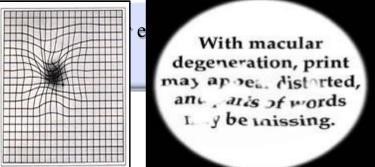
Meaning of age-related macular degeneration (AMD).
An eye condition called age-related macular degeneration (AMD) can cause central vision to blur. It occurs when the macula, the area of the eye that manages precise, straight-ahead vision, deteriorates with age. A portion of the retina is the macula (the light-sensitive tissue at the back of the eye).
What symptoms of AMD are there?
The symptoms of AMD vary depending on the stage. Dry AMD has three stages: early, medium, and late. AMD is a degenerative disease, therefore symptoms usually get worse over time.
- No signs of early dry AMD are present.
- Some people with moderately dry AMD are still symptom-free, some people might only experience slight symptoms, including a modest blurriness in the center of their vision or difficulty seeing in dim light.
- According to numerous reports, late AMD makes straight lines appear wavy or twisted (wet or dry type). You can also notice a hazy spot right in the middle of your field of vision.
- You can also notice a hazy spot right in the middle of your field of vision.
Types of AMD
Both dry and wet forms of AMD exist.
- Most AMD patients have dry AMD (also called atrophic AMD). The macula begins to degenerate at this age. Dry AMD has three stages: early, medium, and late. Typically, steady growth takes years. Although there is no known treatment for late dry AMD, there are methods to maximize your remaining sight
- Wet AMD is a less common type of late AMD that often causes a rapid loss of vision (also known as advanced neovascular AMD). However, wet AMD is always the late stage and can arise at any stage of dry AMD.
Your course of treatment depends on the type of AMD you have.
- Dry AMD cannot be cured, however, visual aids can help you live with the condition less severely. Find out more about managing AMD (at Bharti Eye Foundation).
- To stop future vision loss if you have wet AMD, you could need regular injections into your eyes and, seldom, a procedure called photodynamic therapy to prevent further vision loss.
Read Also:


Comments
Post a Comment